
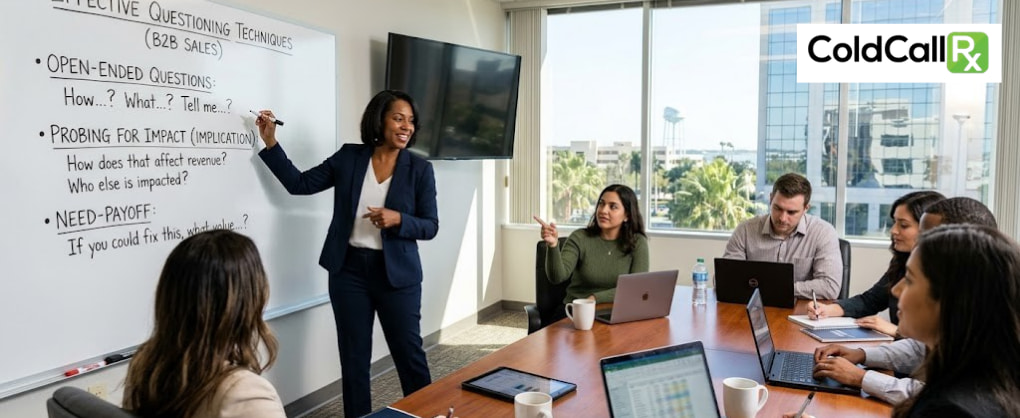
Key Takeaways
- Shift from Pitching to Discovery: Effective questioning guides prospects to uncover their own operational friction and performance gaps rather than forcing them to listen to a rigid feature pitch.
- Match Question Types to the Scenario: Structure conversations dynamically using open-ended (elaboration), probing (root causes), clarifying (confirming details), hypothetical (future vision), and closed-ended (fact/authority verification) questions.
- Follow a 4-Step Structured Framework: Maintain logical momentum in discovery calls by sequencing questions through four distinct phases:
- Situation: Establish current process baselines efficiently.
- Problem: Uncover specific operational friction and delays.
- Implication: Quantify the financial cost of unresolved issues to build urgency.
- Need-Payoff: Prompt the prospect to articulate the value of solving the problem in their own words.
- Adapt Lemov’s Behavioral Principles: Enhance sales call discipline by rejecting vague answers until measurable data is shared (Right is Right) and pushing prospects to explain how their answers impact bottom-line metrics (Stretch It).
- Maintain the 40/60 Ratio and Read Cues: Target a 40/60 talk-to-listen ratio. Evaluate hesitation, vagueness, or defensiveness in real time to adjust tone and question friction immediately.
- Avoid Discovery Pitfalls: Protect deal momentum by avoiding rapid-fire interrogations, sales pitches disguised as questions, easily researchable background queries, and ignoring emotional or tonal cues.
Mastering effective questioning techniques transforms a generic sales pitch into a high-value discovery meeting. Most B2B buyers reject cold calls because reps talk too much about features and not enough about business problems. Asking targeted questions shifts the dynamic from a pushy presentation to a collaborative problem-solving session.
This guide provides a step-by-step approach to structuring sales conversations, handling objections, and improving conversion rates.
What are effective questioning techniques in B2B sales?
Effective questioning techniques are strategic inquiry methods that encourage prospects to share operational challenges, budget constraints, and business goals. Instead of telling a buyer why they need a service, effective questions help the buyer realize the gap between their current performance and their potential goals.
Different conversational situations require specific inquiry types:
- Open-Ended Questions: These questions cannot be answered with a simple “yes” or “no.” They start with words like how, what, or why, encouraging the prospect to elaborate on internal processes.
- Probing Questions: These follow-up inquiries drill deeper into a specific response. They help uncover the root cause of an operational issue.
- Clarifying Questions: Reps use these to confirm understanding and clear up ambiguous statements before moving forward.
- Hypothetical Questions: These help prospects imagine a future scenario where their current problem is completely resolved.
- Closed-Ended Questions: These yield direct, single-word answers. They work best for confirming facts, budgets, timelines, or decision-making authority.
Why do effective questioning techniques matter in cold calling?
Cold calling relies on fast engagement, and targeted questions capture attention within the first ten seconds of a call. When a sales rep makes an outbound call, the prospect is focused on their daily work. Launching directly into a product script causes immediate resistance.
Asking an insightful question interrupts the prospect’s normal reaction. It positions the sales caller as an industry expert rather than a generic telemarketer.
Proper questioning in outbound calls accomplishes four main goals:
- It establishes control of the conversation early without sounding aggressive.
- It screens out unfit leads quickly, saving time for high-value prospects.
- It reveals unstated frustrations about current software, vendors, or workflows.
- It builds trust by proving the rep understands industry-specific friction.
What are the key takeaways from Doug Lemov on questioning?
Educator Doug Lemov created structured questioning techniques in his work on classroom management and skill development. While his framework began in education, top sales leaders adapt his principles to improve sales training and rep performance.
The key takeaways from Lemov’s approach apply directly to B2B outbound sales:
- Cold Calling with Intent: In classroom settings, cold calling means calling on individuals without waiting for volunteers. In sales training, managers use random call-outs during practice sessions to keep reps sharp and ready for unpredictable prospect answers.
- Check for Understanding: Instead of asking vague questions like “Does that make sense?”, reps ask specific questions to confirm the prospect understands the value proposition.
- Right is Right: Lemov emphasizes setting a high standard for correct answers. In sales, reps should not accept vague statements like “things are fine.” They must ask follow-up questions until they get clear, measurable data.
- Stretch It: When a prospect gives a good answer, do not move on immediately. Ask a follow-up question that challenges them to explain the impact of that answer on their bottom line.
Using these principles helps sales reps maintain high standards during discovery calls and live prospecting sessions.
How do you build a step-by-step questioning framework?
A step-by-step questioning framework orders your questions logically. Random questions confuse prospects and make calls feel like interrogations. Following a clear sequence moves the buyer naturally toward a decision.
Step 1: Establish the Baseline (Situation Questions)
Begin by gathering basic facts about current workflows and vendors. Keep these questions brief so the prospect does not feel tested on basic facts.
- Example: “What system are you currently using to manage your remote sales teams?”
- Example: “How many reps are currently making outbound calls each day?”
Step 2: Uncover Operational Friction (Problem Questions)
Identify specific headaches, inefficiencies, or delays in the current setup.
- Example: “Where are your reps spending the most non-selling time during their shifts?”
- Example: “How often do cold outreach campaigns fall short of quarterly pipeline targets?”
Step 3: Quantify the Financial Impact (Implication Questions)
Help the prospect see the real business cost of ignoring the problem. This builds urgency.
- Example: “When lead generation goals are missed, how does that impact your revenue targets for the next quarter?”
- Example: “What does it cost your company when senior reps waste time on unqualified leads?”
Step 4: Confirm the Desired Outcome (Need-Payoff Questions)
Prompt the prospect to state the benefit of solving the problem in their own words.
- Example: “If you could double your team’s qualified meetings without hiring extra staff, what impact would that have on growth?”
- Example: “How would automated lead verification change your weekly workflow?”
How do you analyze prospect responses in real time?
Evaluating prospect answers in real time requires active listening and immediate script adaptation rather than waiting for your turn to speak. Novice reps focus so much on their next question that they miss critical verbal cues.
Pay attention to these indicators during every call:
What You Hear
What It Means
How to Respond in Real Time
Hesitation or long pauses
The prospect is uncertain or guarded about internal data.
Slow your tone. Ask a softer, lower-friction question to reduce pressure.
Vague, general answers
The prospect does not see you as a trusted peer yet.
Use the “Stretch It” technique to ask for a specific example or number.
Quick, defensive replies
The prospect feels interrogated or pressed too hard.
Back up, validate their perspective, and restate your intent to help.
Detailed operational complaints
The prospect is experiencing active pain and wants help.
Deepen the inquiry. Ask how long this issue has been hurting operations.
Adapting to these cues during live conversations keeps the conversation productive and prevents prospects from hanging up.
What common questioning mistakes ruin B2B sales calls?
Even experienced sales professionals can fall into bad habits that derail prospect calls. Avoiding these common traps keeps your discovery process efficient and professional.
- Interrogating the Prospect: Asking rapid-fire questions without acknowledging previous answers feels like an interrogation. Always validate a prospect’s answer before asking the next question.
- Asking Pitch Questions disguised as Discovery: Questions like “Did you know our software reduces churn by 30%?” are sales pitches in disguise. Prospects see through this tactic instantly.
- Asking Questions Found on the Web: Do not waste a decision-maker’s time asking for basic company facts easily found on LinkedIn or their website homepage.
- Ignoring Emotional Cues: Focus on tone, frustration, and emphasis as much as the literal words spoken. Ignoring underlying emotion misses key buying signals.
FAQs
What is the ideal ratio of asking questions to talking in cold calling?
Top-performing B2B sales representatives aim for a 40/60 talk-to-listen ratio. Reps should speak 40% of the time while guiding prospects to talk 60% of the time through targeted questions.
How do you transition from asking questions to presenting a solution?
Summarize the key points shared by the prospect first. Use a phrase like, “Based on what you shared about your pipeline delays and lead quality issues, let me show you how we address those exact gaps.”
What is the difference between open-ended and closed-ended sales questions?
Open-ended questions require detailed explanations (e.g., “How do you evaluate new vendors?”), while closed-ended questions yield short facts or simple confirmative answers (e.g., “Are you the final decision-maker?”).
How do effective questioning techniques handle price objections?
When a prospect raises a price objection, ask clarifying questions like, “Are you comparing this to your current budget, or the cost of leaving the problem unresolved?” This reframes price as an investment in fixing a higher cost.
How do sales managers coach reps on questioning techniques?
Managers review recorded calls, conduct live roleplay sessions, and use call-scoring rubrics to coach reps on question structure, active listening, and smooth follow-ups.
Scale Your Outbound Sales with Expert Cold Callers
Mastering sales dialogue requires time, consistent practice, and dedicated management. If your internal team struggles to maintain consistent call volume while mastering discovery techniques, working with a specialized partner provides an immediate advantage.
Cold Call RX delivers professional, US-based sales callers who understand how to qualify leads using proven outbound techniques. We combine high-quality lead list generation with transparent, real-time reporting so you see exact campaign progress as it happens.
Stop wasting internal resources on cold outreach that yields low response rates. Contact Cold Call RX today to schedule a strategy session and scale your outbound pipeline.